

What is Flat Bed Semi Trailer
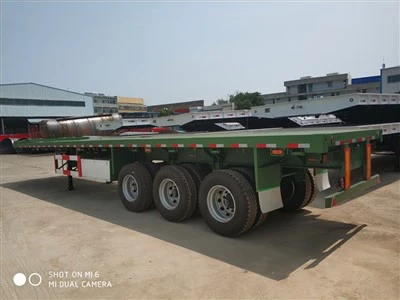
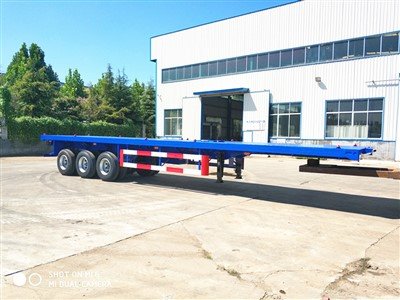
The flatbed semi trailer is a type of trailer whose axle is located behind the center of gravity of the vehicle.The trailer is equipped with a coupling device that can transmit horizontal or vertical forces to the tractor. Part of the total weight of the trailer is borne by the tractor. It doesn’t have itself power, it is carried together with the truck head, and the container carrier semi-trailer is driven by the tractor.Flatbed trailer is usually used to transport 20ft or 40ft containers. They are mainly used for container transportation supporting ships, ports, shipping lanes, highways, transit stations, bridges, tunnels, and multimodal transport. Use platform trailers to transfer cargo at the shipper’s warehouse. Unloaded to the consignee’s warehouse, when changing trailer or boat on the way, there is no need to take the goods out of the box and change them.
Simplified loading and unloading
All sides of the flat bed semi trailerare open, so cargo can be loaded from all angles. At the same time, the goods on the trailer can also be packaged in the most ideal way to ensure safety during transportation.
Available in multiple sizes
There are multiple sizes of flatbed trailers, and you can choose to lengthen or shorten the trailer. If your cargo is iron rods, then an extended flat bed semi traileris very suitable for this purpose. There are many types of flatbed semi-trailers. If you cannot find a trailer that meets the requirements, you can also contact us to customize your flatbed semi-trailer.
Hauls heavy materials
Flatbed trailers have a strong load capacity. From tractors, military equipment, construction materials to containers, flatbed trailers can tow any cargo.
Doesn’t require a loading dock
The flat bed semi trailerdoes not need a loading dock when loading and unloading goods. This is one of the reasons why he has become an ideal choice for many industries.




Why Choose Us
Our Factory
Tongya Automobile Co., Ltd. is listed among the appointed enterprises authorized by the Development and Reform Commission of China (formerly the Economy and Trade Commission of China). We are the first cooperative enterprise whose products are listed in the Public Notice on automobile refitting management. We specialize in full-size truck trailer manufacturing, integrating product design, scientific research and development, production, and sales.
Our Products
Our leading products include Tongyada brand semi-trailers, bulk cement tanker semi-trailers, fuel tanker trucks and trailers, flatbed semi-trailers, side wall semi-trailers, fence semi-trailers, low bed semi-trailers, tipper semi-trailers, water tank trucks, road sweeper trucks, and garbage collection trucks.
Product Applications
Cement tanker semi-trailer: Used for transporting cement from cement plants to mixing stations.
Fuel tanker semi-trailer: Used for transporting fuel from oil companies or oil depots to fuel stations.
Flatbed semi-trailer: Used for transporting containers, sand, stone, bagged goods, pallets, fruits, vegetables, etc.
Our Certificates
"Taishan Quality" Certificate, Certificate of High & New Technological Enterprise, Environmental Management System Certification, Occupational Health Safety Management System Certification, China Famous Brand, Export Enterprise Registration Form, CCC
Types of Flat Bed Semi Trailer
Step or drop deck trailer
A step deck trailer, also referred to as a ‘drop deck’ trailer, is a common alternative to the traditional flatbed. It offers two bed sections of varying heights: an initial taller upper deck at the top steps down to a lower deck closer to the ground. Step deck trailers allow for taller loads at their lowest point, making them extremely versatile. That extra bit of clearance can make a big difference while the height variations allow for more cargo options.
Extendable or stretch deck trailer
An extendable or ‘stretch’ deck trailer is similar to the standard flatbed trailer but has a built-in sliding mechanism offering the ability to extend the length of the cargo bed. These are ideal for items that need more space lengthwise. Stretch decks are also available in a drop deck style.
Lowboy or double drop trailer
Also known as a ‘double drop,’ The drops allow the trailer body to extend below the height of the wheels, maximizing overhead clearance. Lowboy trailers are ideal for hauling items that are extremely tall, as they allow for the most vertical clearance of any flatbed trailer design.
Removable gooseneck trailer (RGN)
An RGN is a unique flatbed design with a gooseneck that can be separated from the rest of the trailer. By removing the neck, the bed can be lowered and used as a ramp for easy loading. They are frequently used to haul oversized heavy machinery such as forklifts and bulldozers, which can be driven right up onto the truck bed for easy hauling.
Conestoga or curtainside trailer
This final flatbed trailer design is an interesting compromise between a standard walled tractor trailer and a flatbed. Curtainside trailers have a built-in sliding tarp mechanism that allows you to cover cargo and protect it from damage and the elements without solid walls. The tarps allow for accessibility on 3 sides when opened, while still providing a layer of protection for sensitive or delicate cargo.
Flat Bed Semi Trailer:Flatbed Dimensions Guide
Standard flatbed : A standard flatbed trailer typically runs between 48 to 53 feet long, 8.5 feet wide, and 5 feet tall. With a standard 5-foot bed height, they can haul items up to 8.5 feet tall.
Step deck: Step deck trailer length runs between 48 to 53 feet long, with an 8.5 feet width. The upper deck follows a standard 5-foot height with a step down to a 3.6-foot-tall lower deck. The lower deck allows for loads up to 10 feet in height.
Extendable flatbed: Stretch flatbed trailers can extend up to 80 feet in length, with a standard 8.5 feet width and 5-foot height. That's quite a bit longer than a 53-foot flatbed, greatly extending capacity for extra-long items.
Lowboy: Common lowboy lengths run between 24 to 29 feet, 8.5 feet wide, with a well height (lowest point) of between 18 and 24 inches. Because they are so low, they have a legal freight height of up to 12 feet.
Curtainside : Curtainside trailers average 48 to 53 feet in length, an 8.5-foot width, 8-foot height, and a standard 5-foot bed height. They do not offer as much height clearance for cargo because of the overhead sliding tarp design.
Application of Flat Bed Semi Trailer
Building and construction materials
As a large building and construction project, bulky materials need to be transported to the job site. These materials may include pipes, rebars, large concrete blocks, steel frames, scaffolding, fence posts, prefabricated buildings, etc.
Recyclables
Recyclables include scrap metal, bald tires, etc. There are many types of scrap metal, from old pipes to residential refrigerators, so flatbed trailers are more suitable for transporting these goods. Because its bed can pile a large amount of material.
Landscaping items
In order to make the city more beautiful, planting full-grown trees is a common method. These full-grown trees are usually transported by flatbed semi-trailers.
Agricultural products
Flatbed trailers have always been the favorite of farmers and ranchers. This is their main means of transporting goods and mobile equipment. Farmers need to tow hay bales to the barn and transport heavy field equipment from one field to another, all of these are achieved by flatbed semi-trailers.
Equipment
Lowbed semi-trailers are usually used to transport large equipment, but sometimes flatbed semi-trailers are also a good choice. Lowbed semi-trailers are used to transport heavy equipment, such as excavators, bulldozers, or other equipment that are inconvenient to disassemble and cannot be driven on the road.
Material of Flat Bed Semi Trailer

Carbon steel material
Carbon steel material is one of the common materials for Flat Bed Semi Trailer. It is relatively cheap, durable and has good load capacity. The disadvantage is that it is easy to rust and needs to be treated with rust prevention frequently.
Stainless steel material
Stainless steel material is a relatively corrosion-resistant material, not easy to rust, and does not need to be treated with rust prevention frequently. However, the price is high, the strength of stainless steel is relatively low, and the load capacity is relatively weak.
Aluminum alloy material
Aluminum alloy material is light and strong. It is not easy to rust and has good expansibility. The price is relatively lower than stainless steel, but the durability of aluminum alloy material is poor and it is easy to damage.
Components of Flat Bed Semi Trailer
Suspension system
Transfer load and absorb vibration.
Axle and hub system
A single, two and three axle assemblies of the same structure are installed under the suspension system.
Landing gear lifting system
In order to make the sidewall trailer reliably parked after being separated from the truck, the front end of the frame is provided with two linkage or single action landing gear. It consists of a screw drive mechanism, a bevel gear drive mechanism, a two-speed reduction gearbox, a transmission rod, an operating handle, and so on.
Traction pin
There is a traction pin connection plate connected to the tractor saddle at the lower part of the front end of the frame. The traction pin is mainly used to transmit the traction of the tractor and the braking force during braking.
Flat Bed Semi Trailer:Preventing Tablet Device Problems
Tyre inflation
Maintaining proper air pressure is essential to prolong the life of flatbed semi-trailer tires. Regularly inspect all tires with a properly calibrated barometer and check for punctures, cuts, or damaged valve core rods. Take extra care to maintain the inside double tires, as wear and tear on these tires may go unnoticed.
Hub ends
Regularly inspect all hubcaps for leaks to prevent water seepage and check for well-lubricated and water contamination at the hub ends. Water intrusion can cause bearing and seal failures, resulting in axle damage. It is important to address the problem of water seepage and maintain adequate levels of lubrication.
Landing gear
Rinse the landing gear and chassis with high-pressure water to remove dirt or sand that has accumulated during use. Lubricating grease fittings. Check that the torque level of the connection points on the landing gear and supports is appropriate. When the flatbed is detached from the truck, you need to rely on the landing gear to stabilize the flatbed, so keeping it maintained can help ensure that your equipment remains level.
Tyre
Always check the flatbed semi-trailer tire pressure regularly and check the tire sidewall for cracks and the tread for excessive wear. For wheels, more specifically, regularly check how tight the nuts are.
Brake
Another important item in the checklist is to check the brake lines and pads for cracks or signs of corrosion. Also, make sure the handlebars are well sealed and the brakes respond when the brake pedal is pressed. Flatbed semi-trailer brake failure is a truck driver's worst nightmare.
Lamp
One of the most important items to check is whether the flatbed semi-trailer lights are completely functional. Make sure the brake lights, tail lights, and signal lights are all working properly. Flatbed semi-trailer lights are an extremely dangerous safety hazard, especially when driving early in the morning or late at night.
Electric
Nowadays, many operations on flatbed semi-trailers are carried out by electrical connections. Regardless of whether the system affects the lighting, cooling, or any other function of the flatbed semi-trailer, it is important to double-check that the electrical connection between the towing vehicle and the flatbed semi-trailer is correct. If using a refrigerated flatbed semi-trailer, pre-run, open the door and visually inspect for corrosion.
Fluids and lubrication
Regarding the fluids and lubrication of flatbed semi-trailers, it is important to remember that the fifth wheel must be properly lubricated to avoid excessive wear. When handling engine fluids, check for any leaks underneath the flatbed semi-trailer. One area that requires special attention is the refrigeration compressor of flatbed semi-trailers. A faulty compressor can cause the refrigeration unit to become inoperable, which can damage the product in the flatbed semi-trailer. Confirming that the refrigeration unit is properly charged and cleaning the condenser and evaporator can help ensure that the system is functioning properly.
Suspension
Checking the suspension of a flatbed semi-trailer is the last area to check. It is important to inspect the flatbed semi-trailer for cracks in the blades, missing or damaged bolts and bushings, and leaks in the shock absorbers.
Why Are Flatbed Semi-Truck Trailers Arched
Height Clearance
Drop deck or step deck trailers have a lower deck height compared to traditional flatbed trailers. This lower deck height allows them to accommodate taller cargo while still conforming to height restrictions on roads and bridges. The arch or step-down in the trailer design helps to achieve this lower deck height.
Loading Flexibility
The arched or stepped design of these trailers can provide additional flexibility for loading and unloading cargo. For example, the step-down section can allow for easier access to the rear of the trailer or facilitate the loading of certain types of oversized or irregularly shaped cargo.
Stability
The arched design of drop deck or step deck trailers can also contribute to improved stability and weight distribution while carrying heavy or bulky loads. The lower center of gravity achieved with the step-down design can enhance the overall handling and safety of the trailer on the road.
Our Factory
Tongya Automobile Co.,Ltd is listed among appointed enterprises to produce and refit automobile approved by Development and Reform Commission of China ( former Economy and Trade Commission of China), the first cooperation enterprise with its products listed in Public Notice on automobile refitting for management. We are the full-size manufacture truck trailer enterprise which integrate the design of product, scientific research developing, production and sale together.


Certifications
"Taishan Quality" Certificate, Certificate of High & New Technological Enterprise, Environmental Management System Certification, Occupation Health Safety Management System Certification, China Famous brand, EXPORT ENTERPRISE REGISTRATION FORM,CCC


FAQ
We're well-known as one of the leading flat bed semi trailer manufacturers and suppliers in China. Please feel free to buy high quality flat bed semi trailer at competitive price from our factory. For customized service, contact us now.
enclosed trailer water tank, wildland water tender, trailer to haul water tank